

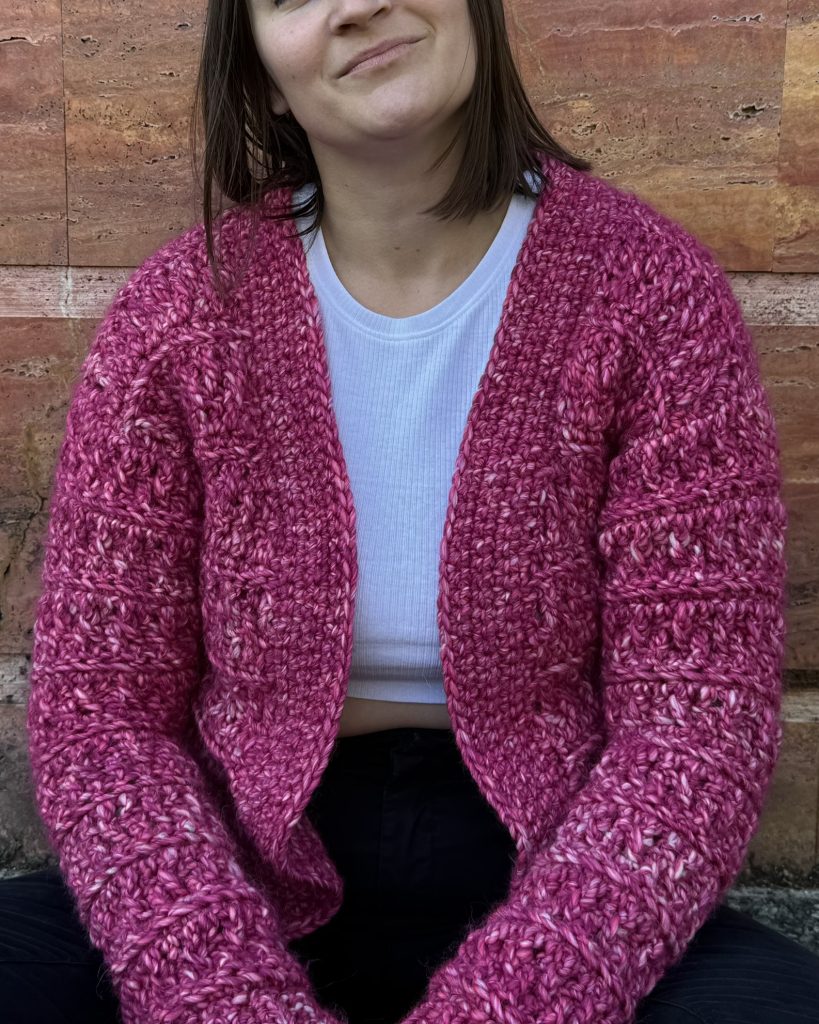
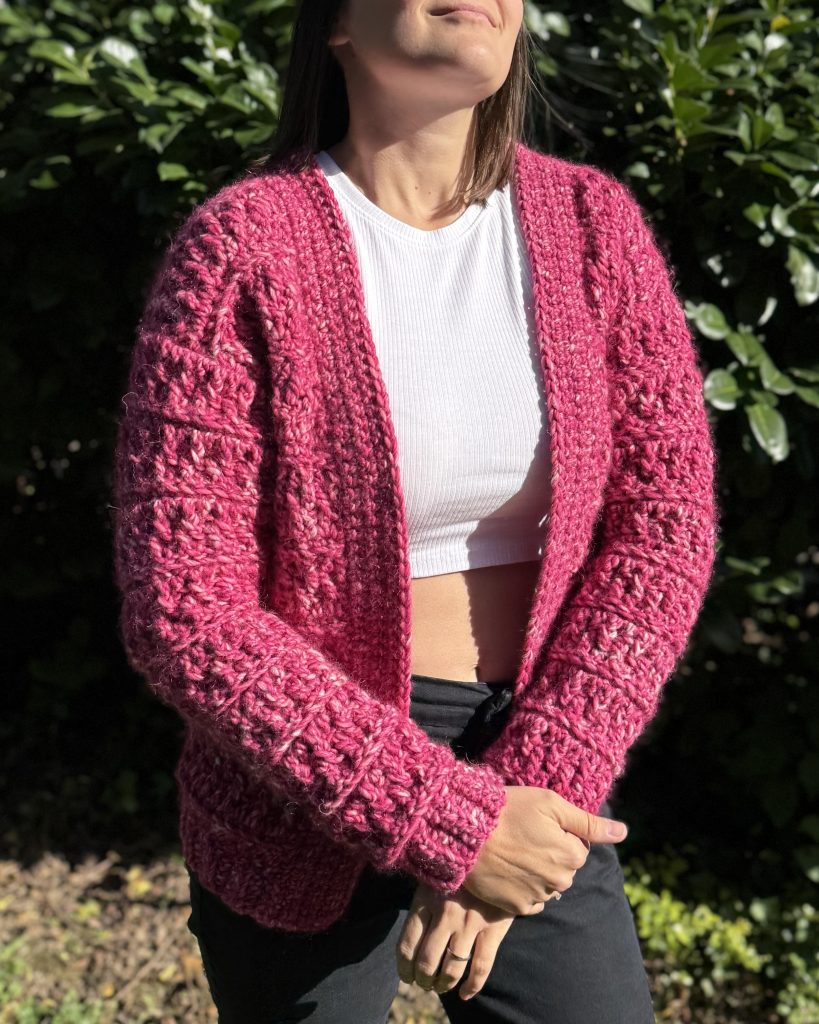
This cozy bulky cardigan is soft, squishy, and perfect for layering on chilly days.
It has a relaxed, oversized fit that’s easy to throw over jeans, leggings, or a dress. Made with chunky yarn and simple stitches, it works up quickly which is great for advanced beginners or anyone who wants a weekend project.
Now, let’s get stitching!
Disclaimer
Please do not copy, redistribute, or resell this pattern in any way, including creating a video tutorial. You may sell your finished piece but please credit me as the pattern designer.
If you share your piece on social media, please credit me as the pattern designer. I would love if you tag me!! I really enjoy seeing your beautiful work.
Gauge
This pattern is made to measure, so you don’t need to obtain any gauge.
Materials
- Bulky yarn of your choice (or any other yarn that you would like to use). I used Bertagna – Goya 418
- Crochet hooks. I used a 9mm hook for the main part and a 7mm for the ribbing.
- Stitch markers
- Sewing needle
- Scissors
- Tape measure
Abbreviations
US terminology
YO – Yarn over
CH – chain
Sk – skip
St – stitch
Rep – repeat
SS – slip stitch
SC – single crochet
HDC – half double crochet
DC – double crochet
BLO – back loop only
FPDC – Front post double crochet
BPDC – Back post double crochet
DC dec – Double crochet decrease
RS – right side
WS – wrong side
Pattern Notes
The pattern is not reversible, meaning you should pay attention to the right side (RS) and wrong side (WS) of your project.
Chain 3 counts as the starting st of the next row (see chart for better understanding)
Chain 1 doesn’t count as the starting st of the next row.
You can replace chain 3 turning chain with stacked single crochet.
You can replace the starting chain and first row of DC with the foundation DC row. In this case, your foundation row should have an even number of DCs.
The pattern could also be made with any other type of yarn.
The front panel sides are determined when wearing the cardigan. Meaning, the right side is your right side when worn and vice versa for the left side.
Measurements
The pattern is made to measure. Before you start, measure these 4 things and mark them down:
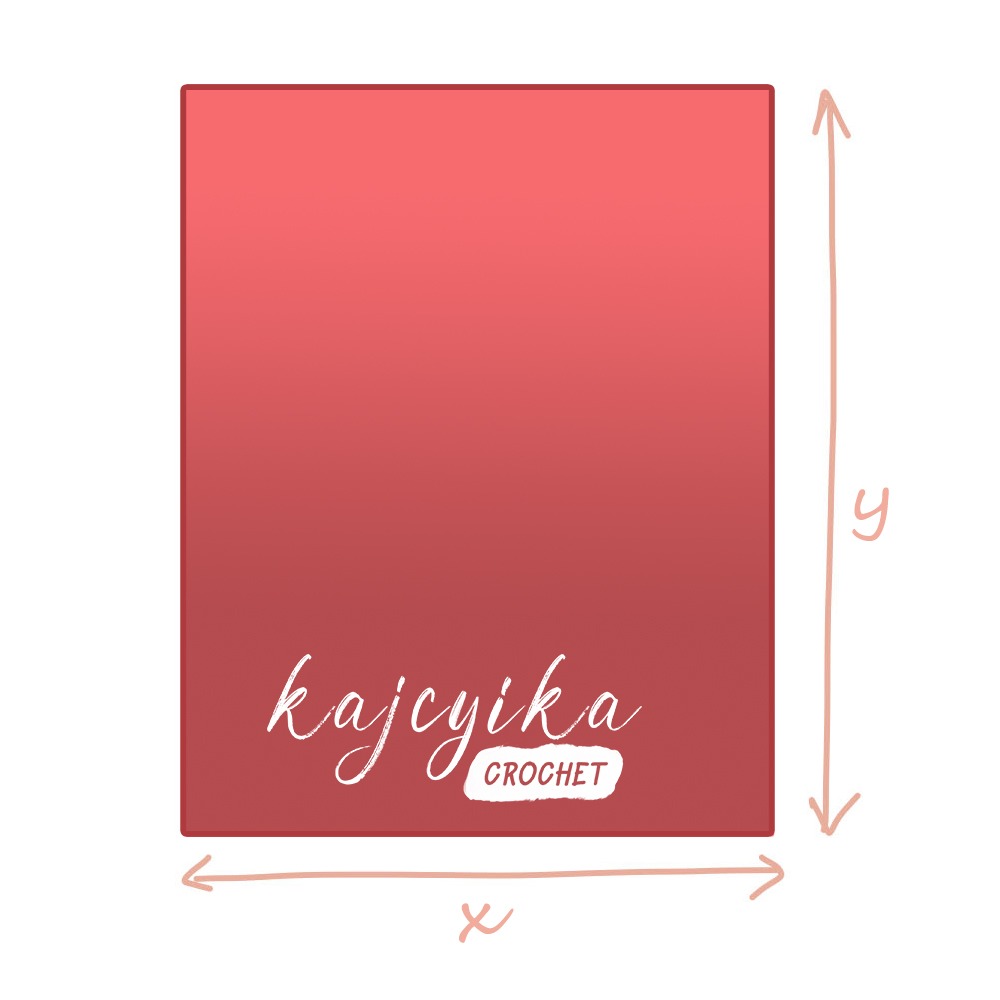
Width (measured as bust size divided by 2)– Measurement X
Length – Measurement Y
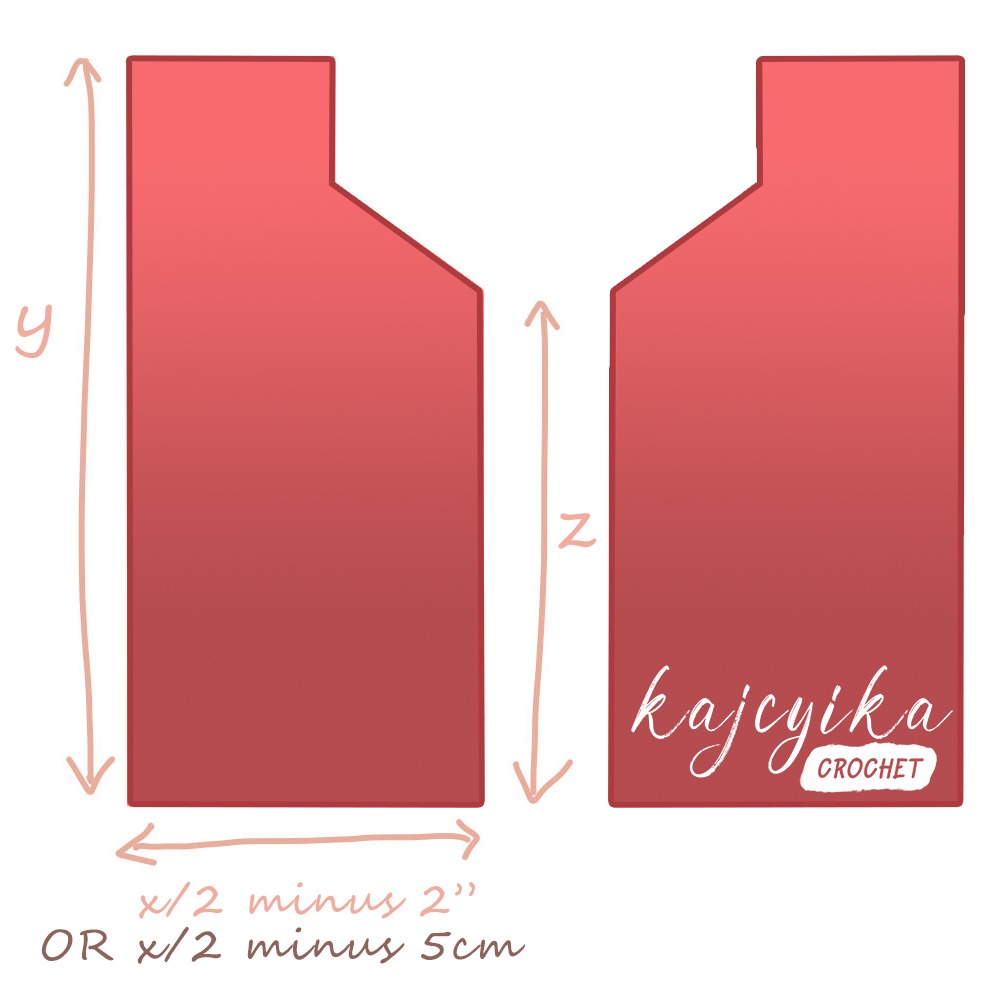
Height of the neckline – Measurement Z
Length of the sleeve without ribbing – Measurement W
Note that the high of the neckline will be the point where the decreases for your neckline will begin. My recommendation is to measure from the bottom up to the center of your chest.
My version was designed to have no ease, which means it’s meant to fit perfectly as is. If you want to make it tighter or wider, you can always change the calculations to have negative or positive ease.
Out of these measurements you can then calculate the remaining measurements as follows.
Width of front panel – Calculated as measurement X/2 – 2” (or Calculated as measurement X/2 – 5cm)
Special stitches
Note: The post is the vertical part of the stitch from the previous row.

FRONT POST DOUBLE CROCHET
YO, insert your hook from front to back to front around the post of the designated stitch (instead of into the top loops)
YO, pull up a loop (you’ll have 3 loops on your hook)
YO, pull through 2 loops
YO, pull through the remaining 2 loops

BACK POST DOUBLE CROCHET
YO, insert your hook from back to front to back around the post of the designated stitch (instead of into the top loops)
YO, pull up a loop (you’ll have 3 loops on your hook)
YO, pull through 2 loops
YO, pull through the remaining 2 loops
PATTERN
Back panel
Row 1: Chain an odd number of chains in the desired width (measurement X).
Row 2: Chain additional 3 and turn. DC into the 4th ch from the hook and to every chain until the end.
At this point your row should be: A starting chain of 3 and the rest are DCs. The number of DCs should be an odd number.
Don’t forget that chain 1 in the next row doesn’t count as stitch, meaning you should do BLO SC in the first DC from the last row.
Row 3 (RS): Chain 1 and turn. BLO SC into all sts until the end, SC to the turning chain.
Row 4 (WS): Chain 3 and turn. DC into all sts until the end.
Note: Remember that chain 3 counts as the starting st of the row, meaning your first DC should be worked into the 2nd SC from the last row. In the end, your row should be: a starting chain 3 and an odd number of DCs. (see chart for better understanding)
Row 5 (RS): Chain 3 and turn. FPDC, *DC,FPDC* until the end. Your last stitch should be FPDC around the turning chain of the previous row.
Row 6 (WS): Chain 3 and turn. BPDC, *DC,BPDC* until the end. Your last stitch should be BPDC around the turning chain of the previous row.
Repeat Row 3 through Row 6 until you reach measurement Y, ending with row 3 (BLO SC row). Cut the yarn and pull through.
Chart:

Front panel
You will need 2 front panels. The first part is the same for both, but you should follow the correct decrease pattern once making the decreases.
Row 1: Chain an odd number of chains in the desired width of the front (measurement X/2 – 2” OR measurement X/2 – 5cm).
Row 2: Chain additional 3 and turn. DC into the 4th ch from the hook and to every chain until the end.
At this point your row should be: A starting chain of 3 and the rest are DCs. The number of DCs should be an odd number.
Row 3 (RS): Chain 1 and turn. BLO SC into all sts until the end, SC to the turning chain.
Row 4 (WS): Chain 3 and turn. DC into all sts until the end.
Row 5 (RS): Chain 3 and turn. FPDC, *DC,FPDC* until the end. Your last stitch should be FPDC around the turning chain of the previous row.
Row 6 (WS): Chain 3 and turn. BPDC, *DC,BPDC* until the end. Your last stitch should be BPDC around the turning chain of the previous row.
Repeat Row 3 through Row 6 until you reach measurement Z, ending with row 3 (BLO SC row). Do not cut the yarn!
Decreases
When crocheting the decreases, the stitches should continue following the same stitch logic sequence.
Count the total number of rows on the back panel and determine how many rows you have left to crochet to get to the same number of rows on the front panel. Divide the number of remaining rows by 4 to get to the remaining number of ‘4 row repeat’ blocks. Write down this number
The calculated number of blocks:__________
Divide the number of blocks by 2 and write down the whole part of the number you get (meaning you should round down).
The calculated number of blocks/2: __________
This number tells you how many decrease blocks you should make. The remaining number of blocks won’t have decreases.
1st side panel:
You should have ended your last row on BLO SC row. Next:
Row 1 (WS): Chain 3 and turn. DC into all sts until two sts remain. DC dec into the last two sts.
Row 2 (RS): Chain 3 and turn. DC into the 2nd DC from the previous row, FPDC into the next st, *DC,FPDC* until the end. Your last stitch should be FPDC around the turning chain of the previous row.
Row 3 (WS): Chain 3 and turn. BPDC, *DC,BPDC* until three sts remain (last two DCs from the previous row and a turning chain 3). DC dec into the last two DC sts, without working into the turning chain from Row 2.
Row 4 (RS): Chain 1 and turn. BLO SC dec, BLO SC into all sts until the end, SC to the turning chain.
These four rows represent one block. Repeat Row 1 through Row 4 until you reach the number of blocks calculated in the previous step, ending with row 4 (BLO SC row). Do not cut the yarn!
Next, crochet the rows without decreasing as follows until you reach the measurement Y ending with row 8 (BLO SC row):
Row 5 (WS): Chain 3 and turn. DC into all sts until the end.
Row 6 (RS): Chain 3 and turn. FPDC, *DC,FPDC* until the end. Your last stitch should be FPDC around the turning chain of the previous row.
Row 7 (WS): Chain 3 and turn. BPDC, *DC,BPDC* until the end. Your last stitch should be BPDC around the turning chain of the previous row.
Row 8 (RS): Chain 1 and turn. BLO SC into all sts until the end, SC to the turning chain.
Once you reach the measurement Y ending with row 8 (BLO SC row), cut the yarn and pull through.
1st side panel chart:
The decrease rows start at the arrow.

2nd side panel:
You should have ended your last row on BLO SC row. Next:
Row 1 (WS): Chain 3. DC into the second st and to all the remaining sts.
Row 2 (RS): Chain 3 and turn. FPDC, *DC,FPDC* until three sts remain (last two DCs from the previous row and a turning chain 3). DC dec into the last two DC sts, without working into the chain from Row 1.
Row 3 (WS): Chain 3 and turn. BPDC, *DC,BPDC* until the end.
Row 4 (RS): Chain 1 and turn. BLO SC until three sts remain (last two DCs from the previous row and a turning chain 3), BLO SC dec into the last DC and BPDC sts, without working into the chain from Row 3.
These four rows represent one block. Repeat Row 1 through Row 4 until you reach the number of blocks calculated in the previous step, ending with row 4 (BLO SC row). Do not cut the yarn!
Next, crochet the rows without decreasing as follows until you reach the measurement Y ending with row 8 (BLO SC row):
Row 5 (WS): Chain 3 and turn. DC into all sts until the end.
Row 6 (RS): Chain 3 and turn. FPDC, *DC,FPDC* until the end. Your last stitch should be FPDC around the turning chain of the previous row.
Row 7 (WS): Chain 3 and turn. BPDC, *DC,BPDC* until the end. Your last stitch should be BPDC around the turning chain of the previous row.
Row 8 (RS): Chain 1 and turn. BLO SC into all sts until the end, SC to the turning chain.
Once you reach the measurement Y ending with row 8 (BLO SC row), cut the yarn and pull through.
2nd side panel chart:
The decrease rows start at the arrow.

Joining

After crocheting all three parts, join them together using your preferred joining method. The panels should be joined so your wrong sides are in the inside of the cardigan. I used a mattress stitch.
The join should be done in the following manner, taking into account that you should leave the arm hole in the size of your arm.
Sleeves
Reattach your yarn to one of your underarm joins. Make sure that you start your base row on the right side in order to get the pattern facing in the right direction.
Base row (RS): SC around the arm opening spacing the stitches equally. My suggestion is to do two or three SC into the CH3 and sides of the DCs, while doing one SC into the side of the SC. Join the round with SS into the first SC. Make sure your base has an odd amount of SC.
Row 1 (WS): Chain 3 and turn. DC into all sts until the starting chain. Join into the 3rd chain.
Row 2 (RS): Chain 3 and turn. DC dec, *FPDC,DC* until the starting chain. Join into the 3rd chain.
Row 3 (WS): Chain 3 and turn. DC dec, *BPDC, DC* until one stitch remains. DC into the remaining st. Join into the 3rd chain.
Row 4 (RS): Chain 1 and turn. BLO SC into all sts until the end, SC to the turning chain.
Continue crocheting until you reach the measurement W ending with row 4 (BLO SC row). Do not cut the yarn!
Sleeves chart:


Next change your hook and use a smaller one. I used a 9mm hook for the main part and a 7mm for the ribbing.
Row 1: Chain 5 (or any other number of chains that is greater than 5 and gives you the desired size of the ribbing)
Row 2: Chain 2 and turn. BLO HDC into the 3rd CH and all remaining CHs.
Row 3: SS into the next 3 St of the base row. and turn. BLO HDC into the top of the first HDC (4th St) and all remaining HDCs.
Row 4: Chain 2 and turn. BLO HDC into the 3rd st (last HDC from previous row) and all remaining HDCs.
Repeat row 3 and 4 until you reach the last base stitch. Join the round by SS through both, the starting chain and BLO of your last row of HDCs. Cut the yarn and pull through.
Final touches
Bottom Ribbing
Reattach your yarn to the bottom of your left front panel, having the cardigan turned to the right side of the project (see green dot at the image below). Use the same hook as you did for the sleeve ribbing. I used 7mm.
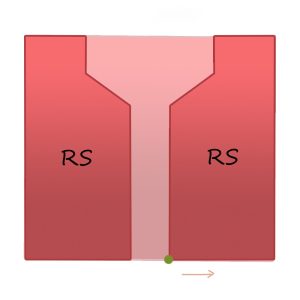
Row 1: Chain 10 (or any other number of chains that gives you the desired width of the ribbing)
Row 2: Chain 2 and turn. BLO HDC into the 3rd CH and all remaining CHs.
Row 3: SS into the next 3 St of the starting chain at the bottom of your cardigan. Turn. BLO HDC into the top of the first HDC (4th St) and all remaining HDCs.
Note: You should be working only at the bottom portion of your cardi. The finish of the front and the neckline will be completed in the next step.
Row 4: Chain 2 and turn. BLO HDC into the 3rd st (last HDC from previous row) and all remaining HDCs.
Repeat row 3 and 4 until you reach the last base stitch, which is at the bottom of the right front panel.
If you ended your round at the base of the front panel – cut the yarn and pull through. If you ended your round at the opposite side (away from the panel) – do not cut the yarn!
Front ribbing and neckline
Reattach your yarn to the bottom ribbing in the corner of your right front panel, having the cardigan turned to the right side of the project (see green dot at the image below). Use the same hook as you did for the sleeve and bottom ribbing. I used 7mm.
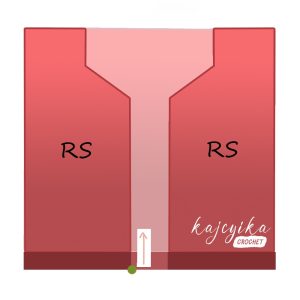
Row 1: SC around the right side, neckline and the left side of the opening spacing the stitches equally. My suggestion is to do two or three SC into the CH3 and sides of the DCs, while doing one SC into the side of the SC. End with a SC into the starting chains of the bottom ribbing on the left panel.
Row 2: Turn. SC into all sts until the end
Repeat row 2 until you reach the width of 2” (5cm) or desired width of the ribbing. In my case I did 6 rows total.
Cut the yarn and pull through.
Weave in the ends and enjoy your cardi!
It’s a very nice pattern. Loved making this cardigan. It looks very smart on top of jeans and skirts.
Thank you so much for being my tester. Love your version!